
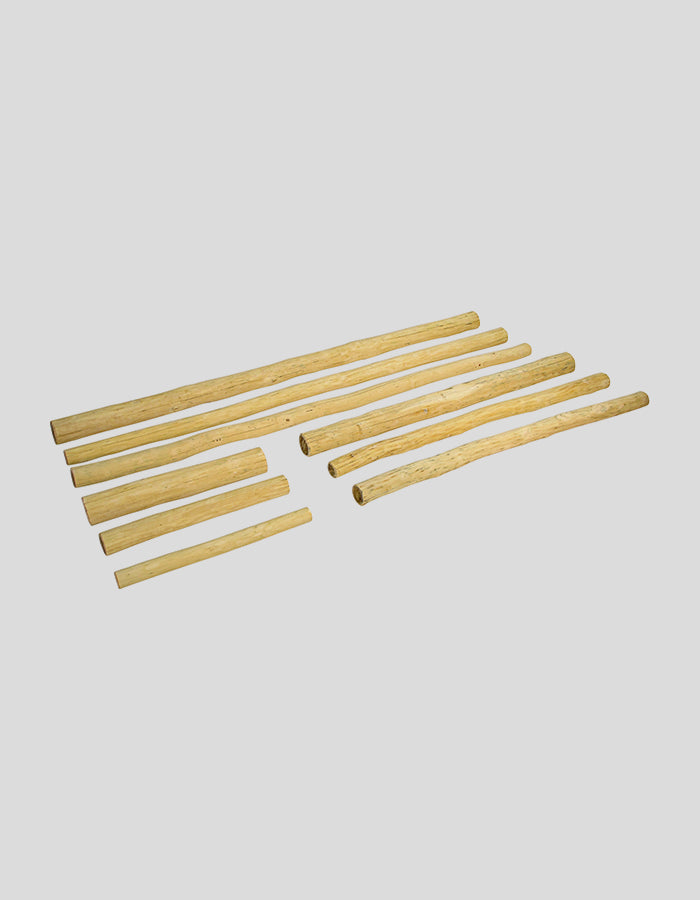

Robinia trunks, extra straight, peeled, smoothed, and sanded
SKU04.02.04.-0001
Delivery time: 14-28 business days
Availability for pickups could not be loaded
Sicher bezahlen mit
Product description:
Robinia wood is the preferred choice for outdoor use, even in soil. No other domestic wood is nearly as durable as robinia wood, see link topic page Properties of Robinia Wood. This does not mean that insulation against soil is unnecessary. A double coat of liquid bitumen (up to about 20 cm above ground) or placing the logs in concrete or gravel significantly extends their lifespan. This way, your logs will last for decades.
These robinia logs "extra straight" come from special varieties of robinia, known as ship mast robinia, which grow almost straight. (The wild form of robinia tends to curve the trunk more or less.) The robinia logs are still not pencil-straight; nature remains nature. There may also be bulges and indentations, especially from embedded branches.
The bark has been removed from the robinia logs. The cambium has also been cleaned. Any larger unevenness has been planed (smoothed). Finally, the logs are sanded.
The ends of the logs are cut straight, at a 90° angle to the log axis, and beveled.
By choosing robinia wood, you are opting for a wonderful product of nature. This is not an artificial, standardized material. Each piece has its individuality, its liveliness through certain irregularities.
Measurement tolerances: The diameter naturally decreases along the log by about 1 cm per 1 m of log length. The specified diameter range applies to the middle of the log (mid-diameter). It should be noted that the log cross-section does not form an ideal circle; it is the average diameter. The tolerance of the specified diameter range is 10%. The specified log length is understood with a tolerance of 2 cm.
Warping and cracks: Wood "lives" because its moisture content – depending on the ambient humidity and climate – affects the dimensions and internal stresses of the wood. Across the grain (radial, tangential), the dimensions can change by up to 6% in practice, while in the direction of the grain (axial) the change is very slight.
Larger internal stresses are released as the wood warps and cracks. This must be taken into account. (Our ancestors, whose main material was wood, did this; we tend to forget it today.)
The above applies even more the harder the wood is; robinia wood is the hardest among woods.
How the wood warps and cracks is not concretely predictable. The drier the wood is, the greater the volume shrinkage and the more and larger the cracks are generally. There can be several cracks, or it can concentrate on just one large crack.
On the other hand, the thickness of the wood is crucial. The thicker the wood is, the greater the volume shrinkage that is "compensated" by the cracks. From wood thicknesses of 6 cm, cracks are unavoidable, no matter how carefully it is dried.
The ambient climate can vary greatly, depending on the region, the microclimate of the location, sunlight, or shade.
Since we do not know the ambient climate at the place of use, we deliver the posts semi-dry, i.e., with a wood moisture content of about 30%, no more. Then there are only minor cracks – in relation to the thickness (see above). In a fully shaded, damp location, the wood will hardly dry out further.
Rapid further drying of the wood in the sun or in a protected place amplifies the stresses in the wood. Then the wood can warp and crack far beyond the inevitable extent. If you need to store the wood, please do so in a shady, cool place.
Important: Cracks do not affect the strength, load-bearing capacity, and lifespan of the wood.

Recently viewed